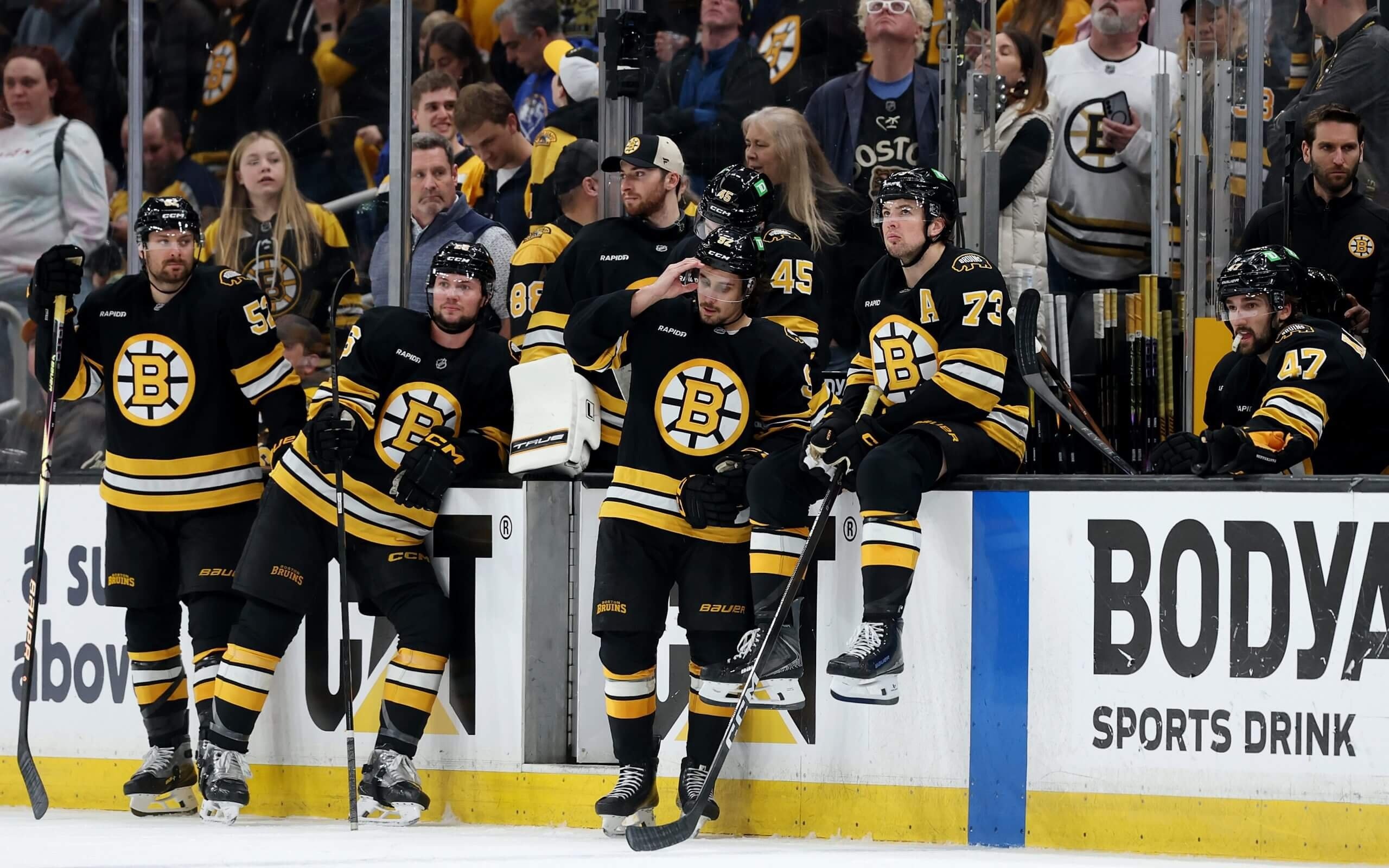
Bruins’ Game 4 Meltdown: 6-1 Loss, Ten Giveaways, Elimination
The Boston Bruins entered Game 4 of the Eastern Conference semifinals with a 2‑1 series lead, but the opening period quickly erased that advantage.
Against the Buffalo Sabres, Boston unraveled with a cascade of miscues that left the team trailing 4‑0 after just 20 minutes of play.
Coach Marco Sturm could offer no immediate explanation, stating after the game, “I can’t. I really can’t,” as the Bruins struggled to find composure.
Defenceman Charlie McAvoy echoed the sentiment, describing the performance as “embarrassing” and emphasizing the need for a rapid reset.
The statistical disparity was stark, with the Bruins outshot 5‑19 and committing 10 giveaways in the first period alone.
Buffalo capitalized on every mistake, turning weak puck handling and poor positioning into four unanswered goals.
Boston’s first‑period breakdown began when McAvoy attempted an outlet pass from behind his net that Jonathan Aspirot mishandled.
Fraser Minten recovered the puck in the neutral zone, but his momentum carried him back into the defensive zone where he lost the puck under pressure from Tage Thompson.
Alex Tuch and Peyton Krebs seized the resulting two‑on‑one rush, with Krebs slamming the puck home to give Buffalo a 1‑0 lead.
Later, a too‑many‑men penalty forced Hampus Lindholm to attempt a clearance that Bowen Byram intercepted, setting up a quick Buffalo response.
Josh Doan redirected a net‑front shot past Jeremy Swayman, extending the Sabres’ lead to 2‑0 before the period’s midpoint.
Jordan Harris, making his Stanley Cup playoff debut, turned the puck over while trying to break out, leading to Zach Benson’s close‑range backhand that rebounded off Swayman’s pad and into the net.
A subsequent Casey Mittelstadt turnover allowed Benson to shoot again, prompting Swayman to freeze the puck for a defensive‑zone faceoff.
On the ensuing draw, Morgan Geekie turned the puck over under heavy forechecking from Jack Quinn, giving Byram another opportunity.
Bowen Byram fired a close‑range shot past Swayman, completing Buffalo’s four‑goal barrage before the first intermission.
Elias Lindholm described the Bruins' play as “very disconnected,” noting that players were spread out and failed to anticipate each other’s movements.
Sturm called a timeout after the third goal at 9:15 of the period, urging his squad to fight back and regain focus.
Despite the coach’s pep talk, the Bruins could not stem the tide, and Byram’s fourth goal effectively sealed the 6‑1 loss.
Sturm admitted that the team was “totally flat in a playoff game” for two consecutive matches, a stark contrast to their regular‑season standards.
In response, the coaching staff made adjustments for Game 4, inserting Lukas Reichel for James Hagens on the third line.
Jordan Harris also replaced Mason Lohrei on the second defensive pairing, aiming to tighten the Bruins’ back end.
These lineup changes, however, could not overcome the systemic issues evident in the first period’s performance.
Sturm emphasized that the burden of turning the series around rests on the team’s veteran leaders, particularly McAvoy, Hampus Lindholm and David Pastrnak.
McAvoy reiterated that the Bruins are “not out of this thing yet,” stressing the importance of mental resilience heading into Game 5.
The upcoming Game 5 at KeyBank Center represents a do‑or‑die scenario for Boston, who must win three straight to stay alive.
Buffalo, riding a surge of confidence after the dominant first‑period display, will seek to close out the series on home ice.
Historically, the Bruins have struggled to rebound from a 4‑0 first‑period deficit in the postseason, making this challenge particularly daunting.
Since the franchise’s inception, Boston has overturned such holes only a handful of times, underscoring the magnitude of the task.
Buffalo’s power‑play efficiency has been a key factor this season, and their ability to convert on the man‑advantage contributed to the early goals.
Conversely, Boston’s penalty kill faltered, allowing the Sabres to capitalize on odd‑man situations with ease.
Analysts note that the Bruins’ turnover margin of ten in the opening period is well above the league average for playoff games.
Turnovers often translate directly into scoring chances, and Buffalo’s quick transition game exploited Boston’s lapses repeatedly.
The Sabres’ offensive strategy emphasized aggressive forechecking, forcing the Bruins into defensive scrambles that they could not escape.
Boston’s defensive corps, normally anchored by Lindholm and McAvoy, appeared out of sync and unable to communicate effectively.
Meanwhile, Buffalo’s forwards displayed poise and precision, taking advantage of every loose puck and misplay.
In the broader context of the Eastern Conference, the series stands as a pivotal moment for both franchises.
The Bruins, seeking to add another Stanley Cup banner, now face an uphill battle that will test their depth and resolve.
Buffalo, still seeking its first championship, aims to cement its status as a rising power with a decisive Game 5 performance.
The following table summarizes the key statistical contrasts from the first period of Game 4:
| Statistic | Bruins | Sabres |
|---|---|---|
| Shots on Goal | 5 | 19 |
| Giveaways | 10 | 4 |
| Goals Scored | 0 | 4 |
The Bruins must address both defensive positioning and puck protection if they hope to reverse the momentum.
Improved breakout execution and tighter coverage in the neutral zone will be essential components of any comeback plan.
Coach Sturm’s next lineup decision will likely focus on pairing experienced defensemen with more reliable puck‑moving forwards.
Player fitness also becomes a factor, as the grueling schedule leaves little room for error or injury.
David Pastrnak, a key offensive catalyst, will need to generate quality scoring chances to spark the Bruins’ attack.
His chemistry with Linus Ullmark and other linemates could provide the spark required to break Buffalo’s defensive shell.
On the Sabres’ side, forward Alex Tuch has emerged as a clutch performer, delivering decisive goals throughout the series.
His ability to find space in tight areas makes him a constant threat that Boston must contain.
Goalie Jeremy Swayman, despite the high shot volume, made several key saves that kept Buffalo ahead.
His composure under pressure will be a critical factor as the series progresses.
For Boston, Jeremy Swayman’s counterpart, Jeremy Swayman, must rebound from a difficult night and limit high‑danger chances.
Sturm’s post‑game remarks indicated a focus on “waking the players up,” suggesting a need for heightened intensity and focus.
The psychological impact of such a lopsided loss cannot be understated, and the Bruins will need to rebuild confidence quickly.
Team captain Brad Marchand, though not mentioned directly in the source, traditionally plays a role in rallying his teammates in adversity.
His leadership, combined with the alternate captains’ efforts, will be vital in restoring belief.
Ultimately, Game 5 will serve as a litmus test for the Bruins’ resilience and capacity to adapt under pressure.
Buffalo, meanwhile, will aim to maintain its aggressive tempo and capitalize on any lingering doubts within the Boston roster.
The series outcome will have lasting implications for both franchises’ postseason narratives and future roster decisions.