Karl-Anthony Towns' Triple-Double Leads Knicks Over Hawks 114-98
The New York Knicks forced a tie in their first‑round series by defeating the Atlanta Hawks 114‑98 on Saturday at State Farm Arena.
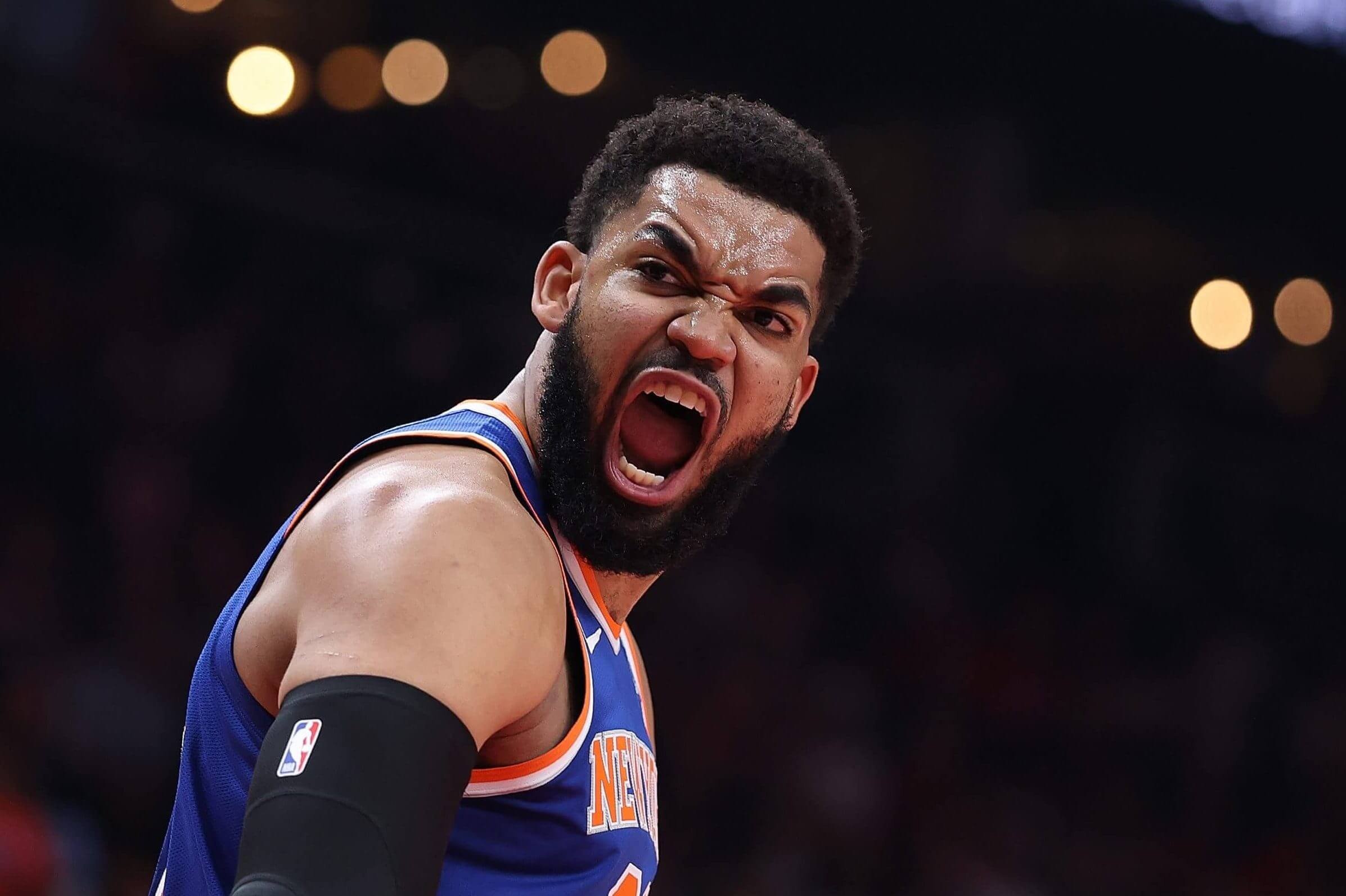
The victory came after New York dropped the first two games, and it was highlighted by a historic triple‑double from Karl‑Anthony Towns.
Towns posted 20 points, 10 rebounds and 10 assists, marking his first playoff triple‑double and placing him among only three other Knicks to achieve the feat—Walt Frazier, Dick McGuire and Josh Hart.
Jalen Brunson contributed 19 points despite briefly leaving the game with an ankle injury in the third quarter, and he returned to finish the contest.
OG Anunoby led the Knicks in scoring with 22 points while also pulling down 10 rebounds, becoming the fourth starter on the night to score in double figures.
The Hawks struggled offensively, shooting 42.5 % from the field and a paltry 21 % from three‑point range, which limited their ability to stay competitive.
Atlanta committed 18 turnovers, a factor that the Knicks capitalized on throughout the game.
CJ McCollum led Atlanta with 17 points, while Nickeil Alexander‑Walker added 15 in what proved to be an insufficient offensive output.
Game 4 also offered a glimpse into coach Mike Brown’s evolving rotation strategy, as he reduced Mikal Bridges’ minutes while increasing the roles of Miles McBride and Jordan Clarkson.
Bridges logged 19 minutes and shot 3‑of‑4, whereas McBride saw 23 minutes and Clarkson 21, both providing valuable scoring and defensive contributions off the bench.
Brown also extended a longer leash to Quentin Alvarado, who played 13 minutes after being limited to single‑digit minutes in the first two games.
Landry Shamet did not see significant action until the game was out of reach, reflecting Brown’s confidence in his core rotation for the remainder of the series.
The Knicks’ bench production was a key factor in the 16‑point margin, with McBride’s perimeter shooting and Clarkson’s aggressive defense helping to sustain the lead.
Brown’s willingness to adjust on the fly aligns with the front office’s desire for a flexible coach following the dismissal of Tom Thibodeau.
While the Knicks have occasionally faltered under Brown’s adjustments in the series, Game 4 demonstrated his ability to push the right buttons when it mattered most.
Atlanta’s fast‑break opportunities were virtually nonexistent, as the Hawks generated only 13 % of their possessions in transition, far below their season average.
The Knicks’ defensive discipline forced the Hawks to operate primarily from half‑court, a scenario in which New York excelled.
Josh Hart, Anunoby and Towns each emphasized defensive assignments, limiting the Hawks’ ability to exploit turnovers for easy transition points.
Jalen Johnson’s performance for Atlanta was underwhelming, as he managed just 14 points on 4‑of‑12 shooting and contributed three rebounds.
Johnson’s inability to break free from Knicks defenders like Anunoby and Hart has been a recurring issue throughout the series.
Across the first four games, Johnson has averaged 19 points per game on an inefficient 19 % field‑goal percentage.
His role as the Hawks’ primary scorer and playmaker has diminished in the postseason, with neither points, rebounds nor assists leading the team.
For Atlanta to avoid elimination, Johnson must elevate his production in both half‑court and transition scenarios when the series returns to Madison Square Garden.
Jonathan Kuminga’s impact has been inconsistent; the Hawks are 11‑1 when he scores at least 10 points, but he shot just 30 % from the field in Game 4.
Kuminga’s 10 points came on 0‑for‑6 shooting from three, contributing to Atlanta’s season‑worst three‑point performance of 21 %.
The Hawks managed only 10 of 41 three‑point attempts, underscoring the importance of perimeter shooting in their offensive scheme.
Atlanta’s inability to stretch the floor allowed the Knicks to collapse the paint and dominate the rebounding battle.
Below is a summary of the key statistical lines from Game 4.
| Team | Points | FG % |
|---|---|---|
| Knicks | 114 | 48.1 |
| Hawks | 98 | 42.5 |
Additional individual statistics highlight the contributions of the starters and key reserves.
| Player | Points | Rebounds |
|---|---|---|
| Karl‑Anthony Towns | 20 | 10 |
| OG Anunoby | 22 | 10 |
| Jalen Brunson | 19 | 4 |
| Mikal Bridges | 8 | 5 |
| Miles McBride | 12 | 3 |
| Jordan Clarkson | 9 | 2 |
For Atlanta, the leading scorers were limited by poor shooting and the Knicks’ defensive pressure.
| Player | Points | FG % |
|---|---|---|
| CJ McCollum | 17 | 45.5 |
| Nickeil Alexander‑Walker | 15 | 38.9 |
| Jalen Johnson | 14 | 33.3 |
| Jonathan Kuminga | 10 | 30.0 |
The series now shifts back to New York for Game 5 on Tuesday, where the Hawks will look to rebound from the blowout loss.
Both teams will likely adjust their lineups, with Brown expected to continue leveraging McBride and Clarkson’s minutes while monitoring Bridges’ production.
Atlanta’s coaching staff, led by Quin Snyder, must find ways to generate more efficient half‑court offense and improve three‑point shooting.
The Hawks may also need to increase the tempo, as their transition play was effectively neutralized throughout the game.
For the Knicks, maintaining the defensive intensity that limited the Hawks to zero fast‑break points will be crucial moving forward.
Continuing to involve Towns as a playmaker could keep Atlanta’s defense off balance, especially if he can replicate the triple‑double performance.
The historical context adds weight to Towns’ achievement, as he joins an elite group of Knicks who have recorded playoff triple‑doubles.
The Knicks have now won three of the first four games in the series, giving them a 2‑2 tie after falling behind 0‑2.
Should they capture Game 5, New York would take a 3‑2 series lead and position themselves one win away from advancing to the conference semifinals.
Conversely, a Hawks victory would force a decisive Game 6 back in Atlanta, reigniting the debate over the effectiveness of Brown’s rotation changes.
The broader implications extend beyond the series, as the Knicks aim to solidify their status as a legitimate contender after a strong regular‑season finish.
Atlanta, meanwhile, seeks to prove that its recent roster additions can compete in the postseason, a narrative that hinges on the performances of Johnson and Kuminga.