Wisconsin Upsets North Dakota 2-1 to Reach NCAA Frozen Four Final
Wisconsin entered the Frozen Four semifinal at T‑Mobile Arena as a clear underdog against a North Dakota squad that had not allowed a goal in the Sioux Falls Regional, posting an 8‑0 combined margin over Merrimack and Quinnipiac.
The Fighting Hawks arrived in Las Vegas ranked No. 2 nationally by the NPI and carried the reputation of a dominant defensive unit, having suffered only one loss by more than three goals all season—a 5‑1 defeat to Minnesota‑Duluth in the NCHC semifinals.
Wisconsin’s path to the semifinal was markedly different, marked by a six‑game losing streak in January that included four home defeats and a 7‑1 loss to Ohio State in the Big Ten quarterfinals.
Just weeks earlier, the Badgers had trailed 3‑1 with five minutes remaining in the Worcester Regional final against top‑seeded Michigan State, yet they rallied to force overtime and ultimately advance.
The Badgers fielded five drafted prospects on Thursday, half the number carried by North Dakota, which also featured a potential top‑five pick in the current NHL draft.
Head coach Mike Hastings, now in his third Frozen Four appearance across his tenures at Minnesota State and Wisconsin, relied on disciplined systems and a strong identity rather than star power to guide his team.
From the opening face‑off, Wisconsin imposed its game plan, using aggressive puck pressure to force turnovers and neutral‑zone battles that disrupted North Dakota’s traditionally solid blue line.
The Badgers out‑shot the Fighting Hawks 18‑4 in the first period, establishing early dominance and setting the tone for the remainder of the contest.
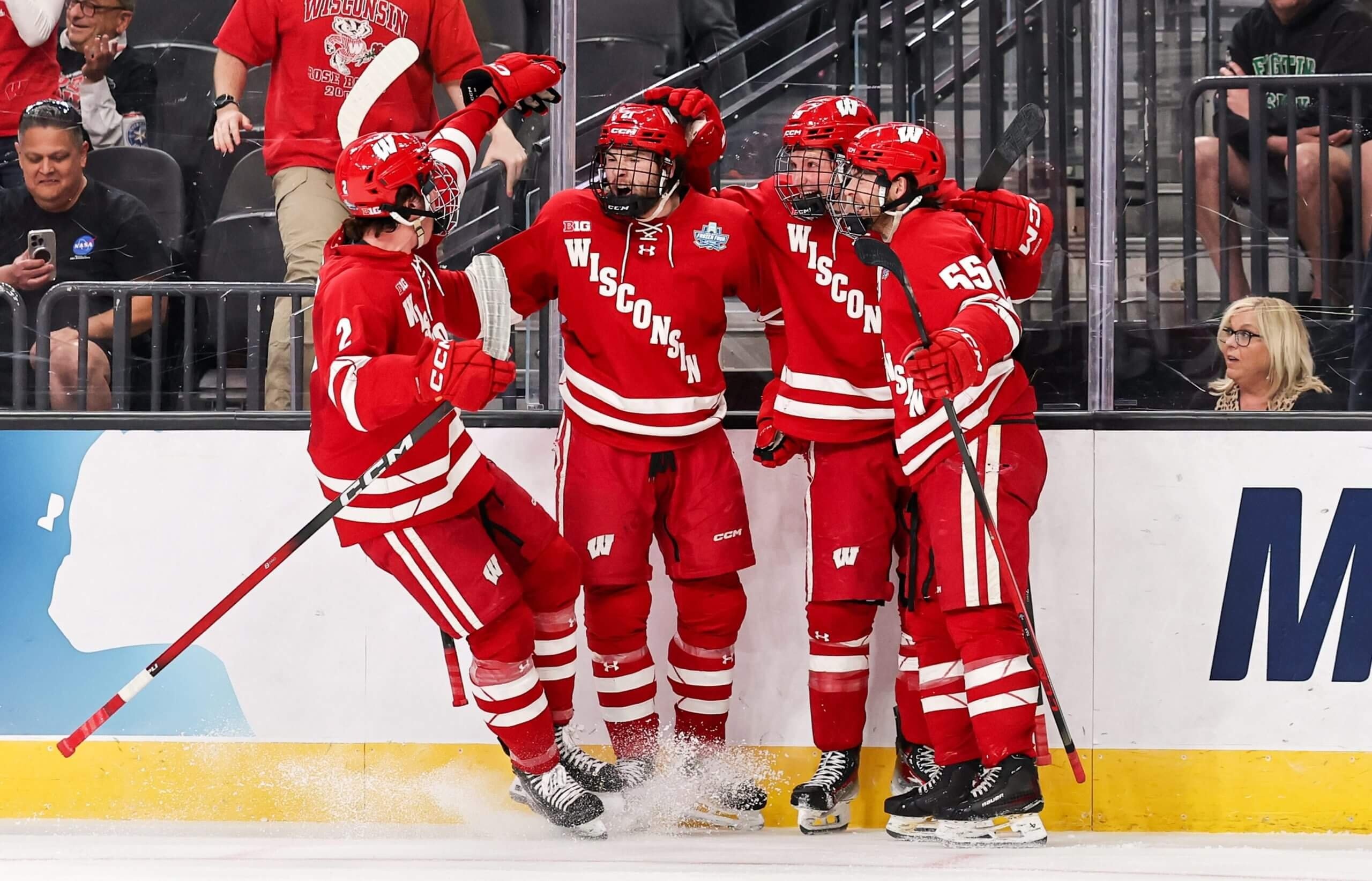
Simon Tassy, coming off the bench, opened the scoring at 7:06 of the first period with a backhanded strike that slipped past goaltender Daniel Hauser.
Just thirty seconds later, Ryan Botterill split a gap in the Fighting Hawks’ defense and fired a blast from the top of the circle to double Wisconsin’s lead.
North Dakota’s defenseman Keaton Verhoeff described the opening period as “heartbreaking,” noting the Hawks’ inability to generate quality chances against Wisconsin’s relentless forecheck.
In the second period, the Fighting Hawks generated five power‑play opportunities but failed to capitalize, while Wisconsin’s penalty kill, rated 70.9 % for the season, kept the Hawks’ momentum at bay.
With 1:57 of a five‑on‑three advantage in the latter half of the second period, Wisconsin killed the penalty after captain Ben Dexheimer left the game with a blocked shot injury.
North Dakota’s lone goal arrived late in the third period when Ellis Rickwood capitalized on a pass from Dylan James, with assistance from Ben Strinden, to pull within one at 52.7 seconds remaining.
Despite the late surge, the Badgers maintained possession and limited high‑danger chances, forcing the Hawks into odd‑man rushes that were repeatedly thwarted by Wisconsin’s goaltender Daniel Hauser.
Hauser finished with 21 saves on 22 shots, delivering a near‑shutout performance that kept Wisconsin’s lead intact for the majority of the game.
North Dakota’s netminder Jan Spunar recorded 35 saves on 37 attempts, standing tall despite being outshot and out‑chanced, and his efforts preserved the narrow margin of defeat.
Both freshman goaltenders demonstrated composure under pressure, with Hauser’s positioning and quick glove work neutralizing the Hawks’ power‑play chances in the final minutes.
Wisconsin’s victory secured its first appearance in the NCAA national championship game since 2010, offering a chance at the program’s seventh title.
The win also highlighted the stark contrast in seasonal trajectories: North Dakota entered the semifinal on a nine‑game unbeaten run, while Wisconsin had rebounded from a mid‑season slump to peak at the right moment.
| Team | Shots on Goal | Goals |
|---|---|---|
| Wisconsin | 18 (1st period) | 2 |
| North Dakota | 4 (1st period) | 0 |
Key statistical contrasts extended beyond the opening period; Wisconsin finished the game with 35 total shots, while North Dakota managed 37, yet the Badgers converted a higher percentage of opportunities.
Wisconsin’s power‑play conversion stood at 0 % for the game, despite three opportunities in the second period, whereas North Dakota’s five power‑play chances also went unanswered.
Both teams entered the Frozen Four with strong special‑teams records: Wisconsin’s penalty kill ranked in the top half of the nation, while North Dakota’s power play had been among the most efficient in the NCHC.
Coach Hastings praised his squad’s resilience, emphasizing that “it doesn’t have to be a Mona Lisa” as long as the team survives and advances.
North Dakota’s Keaton Verhoeff, once a top‑ranked defensive prospect, struggled throughout the game, displaying difficulty with pace and positioning that analysts linked to his recent developmental challenges.
Verhoeff’s limited ice time—13:04 in the regional and 16:50 in the NCHC semifinal—reflected coaching concerns about his readiness for high‑stakes matchups.
Wisconsin’s forward depth, highlighted by the contributions of bench players like Tassy, underscored the team’s balanced attack and depth scoring potential.
Defensively, the Badgers maintained a disciplined structure, limiting North Dakota’s breakout options and forcing turnovers that led directly to scoring chances.
Historically, Wisconsin’s last national title appearance in 2010 ended in a loss, making this semifinal victory a pivotal moment for the program’s resurgence under Hastings.
North Dakota’s program, known for its “Sioux Time” punctuality, arrived ten minutes early for the semifinal but failed to translate that preparedness into on‑ice execution.
The Fighting Hawks’ early breakdowns in neutral‑zone passing and breakout execution allowed Wisconsin to dominate possession and dictate the flow of play.
Both teams’ draft‑eligible players will now carry the experience of a Frozen Four final appearance into their respective NHL development paths.
Wisconsin’s advancement sets up a championship showdown that will test the Badgers’ ability to sustain their identity‑driven approach against a top‑seeded opponent.
For North Dakota, the semifinal loss serves as a learning experience for its young core, particularly the defensive prospects who must address pacing and decision‑making at the collegiate level.
Overall, the semifinal highlighted the unpredictable nature of college hockey, where disciplined systems and timely execution can overcome disparities in draft pedigree and season‑long statistics.