Groundhopping Journey: How English Football Changed Over 43 Years
David Marples’ 43‑year ground‑hopping odyssey began in 1982 on a crumbling terrace and concluded on a drizzly December afternoon in a brand‑new stadium named after an international commercial law firm.
The final match, a 3‑0 defeat for his team, was watched from the away end, mirroring the experience of many of his visits where he supported Nottingham Forest as a travelling fan.
Across the four decades, Marples observed the gradual disappearance of the traditional pub‑ground relationship, noting that once‑iconic establishments such as Griffin Park’s corner pub have largely vanished.
He highlights that the modern stadium now incorporates its own bar within the stand, a response to clubs’ desire to capture additional revenue from fans who no longer have nearby public houses.
The shift from external pubs to internal hospitality reflects a broader commercialisation trend, as clubs increasingly focus on footfall and ancillary income streams.
Marples also points out the resurgence of safe standing, which moved from being regarded as a fantasy to a common feature in higher‑league grounds within a short period.
Safe standing areas now allow fans to stand behind the goal while maintaining safety standards, demonstrating that supporters can enjoy modern amenities without sacrificing tradition.
He describes the emotional impact of recreating famous goals at new venues, such as the Jimmy Glass moment that secured Carlisle United’s league status, suggesting that these sites deserve virtual blue plaques.
Researching figures like Percy Ronson of Fleetwood and Eric Whalley of Accrington reveals why clubs name stands or bars after them, underscoring the growing reverence for local legends.
Marples contrasts English fan culture with the German ultra model, noting that English supporters have begun to adopt flag‑waving and chanting practices while also developing a distinct visual identity.
He observes that some fan groups have embraced an all‑black uniform, a trend that can appear exclusionary and conveys an unintended sense of superiority.
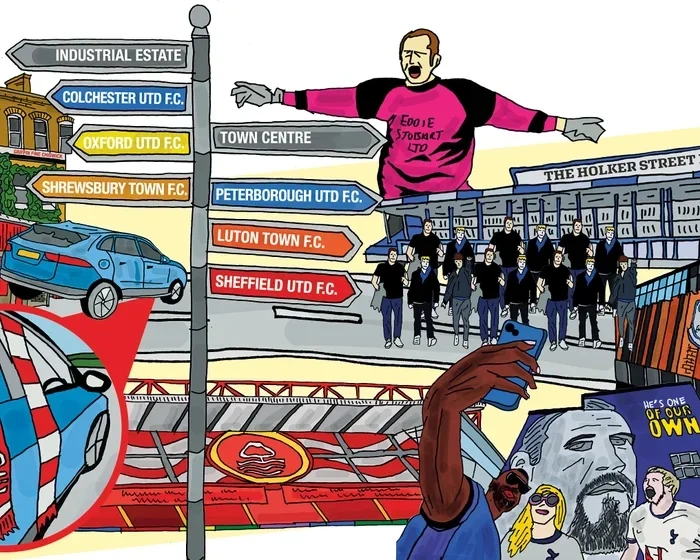
Barrow’s supporters exemplify a “baby squad” mentality, gathering at the Holker Street End to celebrate goals and create a unique atmosphere for away fans.
Large club‑approved flags now dominate the stands, often requiring prior permission, which indicates clubs’ desire to control the spectacle while still encouraging fan participation.
Marples argues that allowing supporters to manage flag‑waving independently would enhance authenticity and reduce administrative barriers.
Club shops’ end‑of‑season bargain bins provide an opportunity to acquire unusual memorabilia, with Walsall’s £10 shirts emblazoned with “Poundland” serving as a notable example.
Sponsorship signage offers a glimpse into the commercial landscape, from “Betterwave” at Accrington to “D Catchesides Roofing” in Bromley, illustrating the diverse range of local businesses involved in football.
He notes the prominent “Britcon” hoarding at Scunthorpe, which prompts reflection on contemporary political and social issues linked to stadium advertising.
In north‑west venues, Rainham Steel advertisements are a common sight, reinforcing the regional character of corporate partnerships.
Organised fireworks displays have become a regular feature in lower‑league matches, receiving more promotion than many high‑profile concerts, according to Marples.
Murals around stadiums now form part of the match‑day experience, offering fans an opportunity to seek out depictions of club heroes and strengthen local identity.
These visual installations encourage visitors to pause, recognise former players, and engage with the club’s heritage in a non‑threatening manner.
Despite the many changes, certain constants persist, such as the seasonal transition from hazy autumn sunshine on entry to wintry darkness on exit, marking the completion of a Saturday.
Marples recalls the universal Monday‑morning query from colleagues, “Did you do anything nice at the weekend?” as a testament to the personal fulfillment derived from ground‑hopping.
| Decade | Key Development | Representative Example |
|---|---|---|
| 1980s | Terrace culture dominant | Crumbled stand at first ground |
| 1990s | Pub closures near grounds | Griffin Park’s corner pub shuttered |
| 2000s | Introduction of internal bars | Bar built into new stand |
| 2010s | Safe standing implementation | Uphill Safe Standing areas |
| 2020s | Flag‑waving formalisation | Club‑approved big flags |
The evolution of stadium architecture from open terraces to all‑seater venues with integrated hospitality reflects a shift in fan experience priorities.
Modern stadiums now balance commercial imperatives with preserving elements such as safe standing, ensuring that traditional supporter behaviours remain viable.
Marples’ narrative underscores the importance of physical place, noting that walking to a ground within town centre limits offers a “big day out” feeling absent from industrial estates or science parks.
He extends an apology to clubs like Colchester, Oxford, and Shrewsbury for any perceived neglect, while acknowledging positive experiences at Luton, Peterborough, and Sheffield United.
The article emphasizes that the presence of a local pub once served as a visual declaration of allegiance, a practice now supplanted by executive car stickers and personalised number plates.
This change, according to Marples, has diminished the communal expression of support that once enlivened town‑centre streets.
Despite the commercialisation of fan identity, Marples finds value in the renewed prominence of murals and flag‑waving, which contribute to a sense of belonging without overt regulation.
He suggests that clubs should relinquish control over large flag displays, allowing organic fan‑led spectacles to flourish.
In the realm of memorabilia, end‑of‑season discount sales provide fans with affordable access to club apparel, exemplified by Walsall’s low‑cost shirts.
These sales also serve clubs’ marketing strategies, diverting attention toward new kit launches while clearing inventory.
Advertising hoardings continue to dominate the visual landscape of stadiums, offering insight into regional businesses and broader socio‑political dialogues.
Marples notes that the sheer volume of fireworks promotion in lower leagues rivals that of major music events, highlighting the entertainment diversification within football venues.
Overall, the 43‑year odyssey illustrates a football culture in flux, where tradition coexists with modern commercial pressures, yet the core experience of attending a match remains a cherished ritual.