Notre Dame Spring Football Open Practice Recap: Jasper Scaife 56‑Yard Punts, Spencer Porath’s Long Field Goals, and Fres
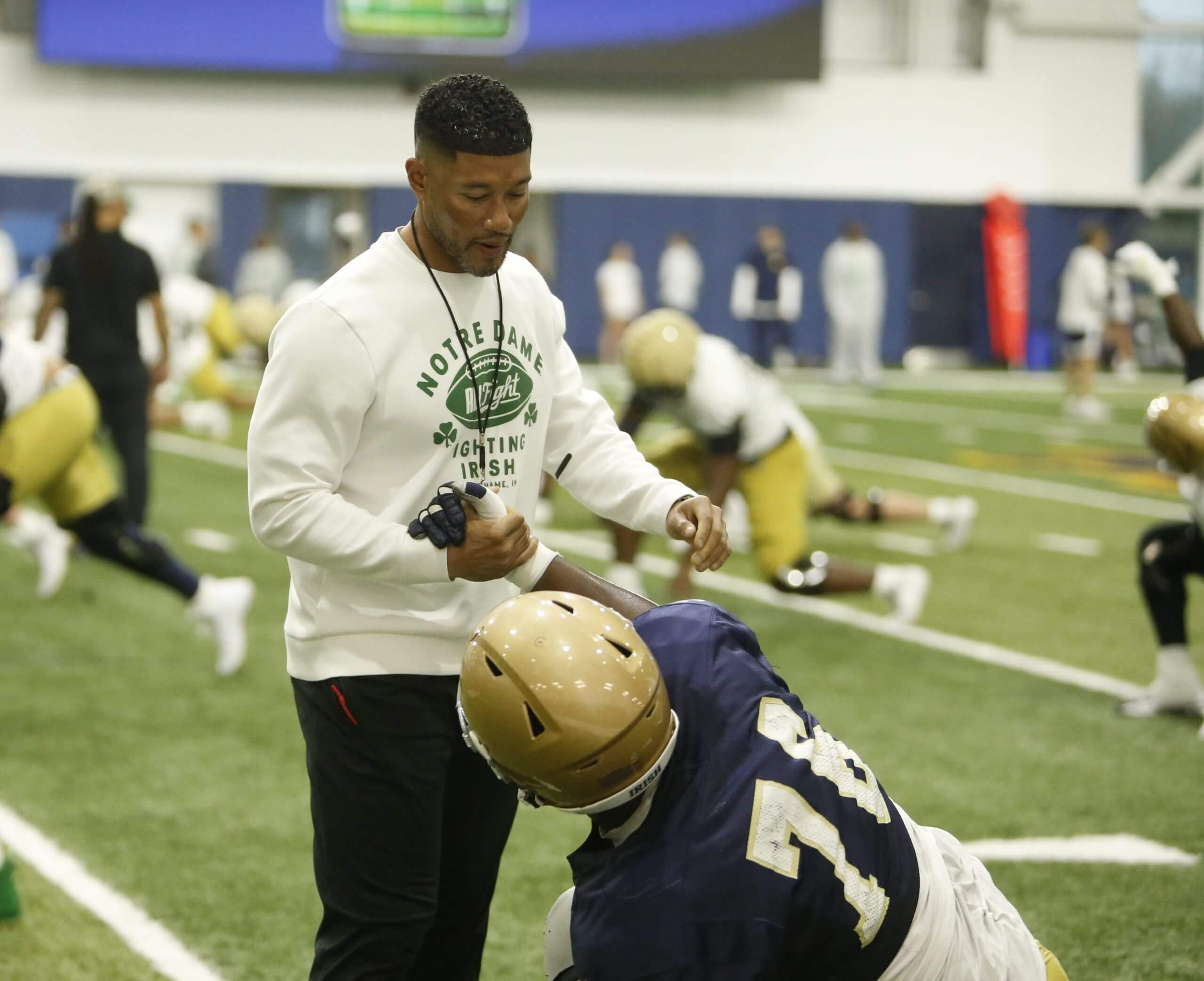
Marcus Freeman monitored the entire roster from the stands of the Irish Athletics Center on Saturday morning while greeting roughly a dozen recruits and former players such as Riley Leonard and Sam Hartman.
The session was the first 11‑on‑11 scrimmage of the spring cycle, a “moving day” that allows players to stake a claim for larger roles before the Blue‑Gold Game concludes the practice period.
Positional drills and special‑teams work filled the first half hour, after which the hour‑plus scrimmage showcased both the depth of Freeman’s fifth‑year squad and the areas that still require reinforcement.
Special‑teams coordinator Marty Biagi highlighted punter Jasper Scaife’s performance, noting that the Australian import’s punts resembled “a pitching wedge that sticks on the green” from 45 yards out.
Scaife followed his initial kicks with a 56‑yard and a 57‑yard punt, punctuated by a 36‑yard shank, demonstrating a wide range of distance and control.
New kicker Spencer Porath, a Purdue transfer, calmly converted field goals from 30, 38, 44, 47 and 57 yards, suggesting an upgrade from last season’s unit that failed to make any attempts.
Wide receiver Jaden Greathouse was limited to the back of the group due to a lingering hamstring injury that also kept him out of the scrimmage and likely the upcoming Blue‑Gold Game.
Linebacker Madden Faraimo wore a white jersey and avoided full contact, while nickelback Dallas Golden missed practice entirely because of a back injury.
Quarterback Blake Hebert, nursing a knee tweak from the previous week, did not participate, opening the field for freshman Noah Grubbs, who displayed a “Kool‑Aid Man” style of entering the pocket.
Freshman safety Joey O’Brien made his first appearance in drills, showing length and suddenness, though his physical development suggests he may need additional weight‑room work before matching five‑star peers.
Defensive‑line drills featured a hula‑hoop exercise that emphasized low shoulder positioning; junior Bryce Young performed the drill more nimbly than a year ago, shedding excess weight while maintaining a 6‑foot‑6, 260‑pound frame.
In the punt return unit, Aneyas Williams, Mylan Graham and Jaden Greathouse took turns, with Williams holding a career total of 443 rushing yards and seven touchdowns for the Irish.
The final punt of the special‑teams segment was a strategic “bad coaching decision” when Scaife hesitated at midfield and then punted from the opponent’s 1‑yard line, pinning the returner at the goal line.
The scrimmage opened with the first‑team offensive line from left to right: Will Black, Anthonie Knapp, Joe Otting, Sullivan Absher and Guerby Lambert.
Starting backfield players included running back Nolan James Jr., receivers Micah Gilbert and Jordan Faison, tight ends Ty Washington and Cooper Flanagan, with CJ Carr in a goal‑line package.
Notre Dame’s offense improved over last spring, converting a 1‑for‑4 series from the 2‑yard line with a gritty James run, though Carr’s sole pass attempt was broken up by nickelback Christian Gray.
In 11‑personnel, the receiving corps featured Faison, Gilbert and Graham, while the secondary fielded safeties Tae Johnson and Adon Shuler, corners Leonard Moore and Mark Zackery IV, and nickelback Gray.
Oregon transfer defensive tackle Tionne Gray showed his impact by double‑teaming James for a short gain, celebrating as he had done after beating USC while at Oregon.
On third‑and‑8 from the 32‑yard line, Carr read Chris Ash’s “drop eight” call and found Faison for a 20‑yard gain, demonstrating his ability to locate open space even against a full defensive front.
Three plays later, Carr attempted a pass to James in the corner of the end zone on third‑and‑5 from the 7‑yard line; James secured the ball but stepped out of bounds, illustrating the quarterback’s willingness to target a running back against a linebacker.
Porath added a 25‑yard field goal, extending the Irish lead and highlighting his reliability from range.
Freshman Grubbs led the two‑deep unit onto the field, protected by a line of Styles Prescod, Sullivan Garvin, Cam Herron, Chris Terek and Matty Augustine, which held up well against the backup defense.
The second‑team defense comprised ends Rodney Dunham and Ebenezer Ewetade, tackles Sean Sevillano Jr. and Armel Mukam, linebackers Ko’o Kia and Teddy Rezac, corners Chaz Smith and Ayden Pouncey, nickelback Jayden Sanders, and safeties Luke Talich and Joey O’Brien.
Freshman running back Jonaz Walton immediately produced a strong run, signaling his readiness to contribute despite the Irish’s limited depth at the position during spring.
In the third‑team “Basics” unit, Grubbs executed an RPO and connected with Devin Fitzgerald for a 65‑yard touchdown on a slant, underscoring the speed differential between scholarship players and walk‑ons.
Offensive‑line play on the left side, particularly from Knapp and Black, displayed classic Notre Dame traits, with both linemen consistently beating interior defensive linemen.
Tight end Cooper Flanagan proved a difficult matchup for linebacker Jaylen Sneed, repeatedly punishing him and sparking a series of on‑field confrontations.
On a third‑down play, Carr opted for a 21‑yard pass to Graham after a defensive line offside, illustrating the tendency to give the quarterback “free plays” during practice.
Defensive end Dunham beat Black at the point of attack, marking the only loss Black suffered in the session, while Lambert and Absher showed areas needing further development.
James scored on a decisive jump cut near the goal line, capping a drive that highlighted the offensive line’s ability to open lanes despite occasional back‑field pressure.
A mis‑snap from backup center Cam Herron over Grubbs’ head resulted in a fumble out of the end zone, emphasizing the ongoing need for a reliable backup center while starter Ashton Craig recovers from an ACL tear.
Walton’s 24‑yard run further demonstrated his potential to fill the Irish’s spring‑time running‑back void.
Lambert, shifted to tackle, was beaten inside by Traore, prompting Carr to find Williams on a short third‑and‑8 conversion.
Porath capped the drive with a 44‑yard field goal, maintaining the tied score at 31‑31.
Grubbs, under immediate pressure, delivered a swing pass to Walton that was blown up by Ewetade, resulting in a 6‑yard loss but showcasing the defensive ends’ disruption ability.
Talich intercepted a Grubbs pass that could have been a pick‑six had not for a diving tackle by Herron, reinforcing his versatility as a third‑best safety and occasional edge rusher.
O’Brien made a solid stop at the line of scrimmage, limiting Walton to a 2‑yard gain and hinting at his future impact in the secondary.
Grubbs threw a precise touchdown pass between O’Brien and Ethan Long, caught by Fitzgerald (or possibly Logan Saldate), highlighting his quick decision‑making and accuracy.
Freeman’s comments about Grubbs suggest the freshman could emerge as a contender for the starting quarterback role, though the arrival of Teddy Jarrard this summer adds competition.
Overall, the offensive lines performed strongly, and Carr’s rapid release and pre‑emptive reads helped mitigate pressure throughout the scrimmage.
On a subsequent play, Carr connected with Faison for a 42‑yard gain over Zackery, exposing the disparity between Moore, who limited coverage, and Zackery, who faced the majority of the route.
Walton’s 37‑yard burst later in the session reinforced his growth as a college‑level running back, a development Freeman praised during the practice.
Traore continued to dominate Lambert, while Carr’s ability to escape the pocket and deliver accurate throws remained a highlight of the day.
Mukam’s bull rush forced Absher back into the pocket, yet Carr lofted a 17‑yard pass to Graham, illustrating his poise under duress.
Former offensive coordinator Tommy Rees noted that a quarterback’s success hinges on interpreting defensive questions, a skill Carr displayed by anticipating Ash’s schemes.
Flanagan and Sneed engaged in a third round of physical battles, underscoring the intensity of intra‑team competition during spring practice.
Porath’s consistency continued with a 40‑yard field goal, even after Freeman called a timeout to “ice” him, a tactic used against Purdue’s kicker last season.
The defense surrounded the kicking unit, with Sneed taunting Porath, yet the kick remained successful, cementing Porath’s reliability for potential game‑winning situations.
| Player | Position | Key Spring Performance |
|---|---|---|
| Jasper Scaife | Punter | 56‑yard, 57‑yard punts; 36‑yard shank |
| Spencer Porath | Kicker | FGs from 30, 38, 44, 47, 57, 40 yards |
| Noah Grubbs | Quarterback (Freshman) | 65‑yard TD run; multiple 20‑plus‑yard passes |
| CJ Carr | Quarterback (Senior) | 20‑yard gain on 3rd‑and‑8; 42‑yard pass to Faison |
| Jonaz Walton | Running Back (Freshman) | Runs of 24, 37 yards |
| Joey O’Brien | Safety (Freshman) | Key stops; third‑best safety in practice |
Freeman’s fifth‑year roster exhibited depth across the board, with several players—particularly on the offensive line and secondary—showing marked improvement over previous spring cycles.
The progression of players like Bryce Young, who trimmed weight while preserving size, and the emergence of freshman contributors such as Grubbs, O’Brien and Walton, suggests a balanced blend of experience and new talent for the upcoming season.
Notre Dame’s spring scrimmage did not resolve all roster questions, but the detailed observations provide a clear picture of where the team stands as it approaches the Blue‑Gold Game and the fall campaign.