Knicks Set NBA Record with 47‑Point Halftime Lead vs. Hawks
The New York Knicks entered Game 6 of their Eastern Conference series at State Farm Arena with the series tied, knowing a win would force a decisive Game 7 in New York. The Atlanta Hawks, facing elimination, needed a victory to stay alive and avoid a trip to Madison Square Garden.
From the opening tip, the Knicks imposed a relentless pace, converting early buckets and forcing turnovers that quickly turned the contest into a blowout. By the three‑minute mark the Hawks trailed 9‑5, and that would be the last time they led before halftime.
New York’s offensive efficiency exploded as the first half progressed, culminating in an 83‑36 lead at the break. The 47‑point halftime margin set a new NBA playoff record, surpassing the previous 41‑point mark shared by the 2025 Indiana Pacers and the 2017 Cleveland Cavaliers.
The magnitude of the lead approached the all‑time largest halftime advantage in any NBA game, regular season or postseason, which stands at 50 points. The Knicks’ performance underscored their dominance in the series and placed the Hawks in an almost insurmountable position.
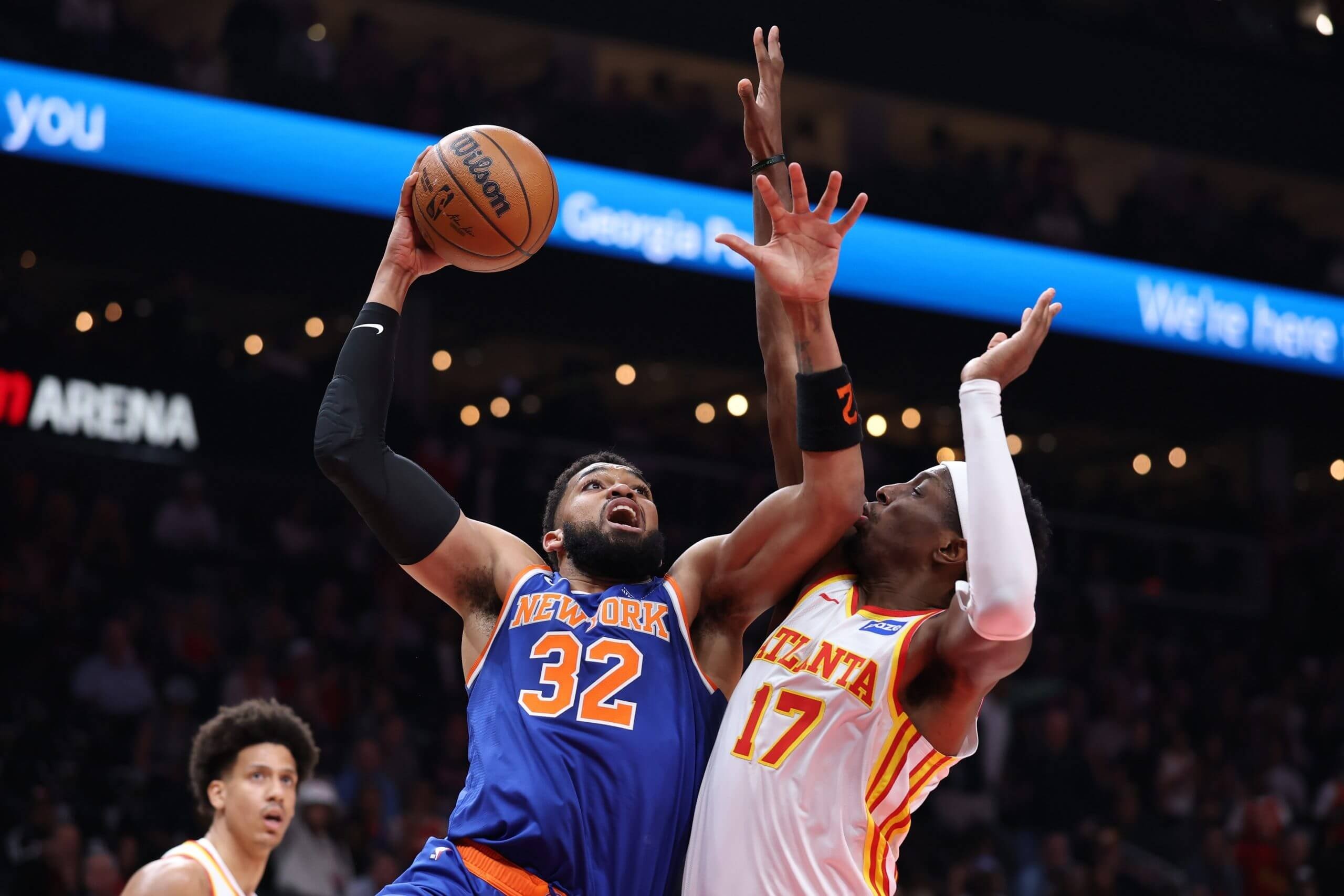
Knicks guard OG Anunoby was the offensive catalyst, pouring in 26 points on an efficient 10‑of‑12 shooting in the first half. His scoring outburst contributed to New York’s 65.1 % field‑goal percentage and 43.8 % success rate from three‑point range.
Seven of the Knicks’ made three‑pointers came in the opening half, stretching the Hawks’ defense and opening driving lanes for the interior. The Knicks’ balanced attack featured both perimeter shooting and strong post play from Mitchell Robinson.
Robinson’s presence in the paint was a double‑edged sword, as a heated exchange with Hawks forward Dyson Daniels erupted with 4:39 left in the half. Daniels threw an elbow at Robinson’s rib cage, prompting Robinson to retaliate by grabbing Daniels around the neck and walking him several feet.
The confrontation escalated, drawing both benches onto the floor and causing Knicks coach Mike Brown to fall while attempting to separate the players. After review, officials issued offsetting technical fouls to both Robinson and Daniels, resulting in their ejection from the game.
The Knicks’ roster gave a standing ovation as Robinson exited, a gesture reflecting the team’s solidarity and the emotional intensity of the moment. The incident highlighted the physical stakes of a high‑pressure playoff environment.
Defensively, New York forced 12 steals in the half, matching the total number of field goals the Hawks managed to convert. This aggressive defensive pressure contributed to the Knicks’ fast‑break opportunities and second‑chance points.
The Hawks managed only 36 points in the first half, struggling to find rhythm against New York’s suffocating defense. Their shooting woes were evident, as they failed to capitalize on the few open looks generated by their own ball movement.
Comparatively, the 2025 Pacers’ 80‑39 halftime lead over the Cavaliers featured a 60 % field‑goal conversion and 12‑of‑18 three‑point shooting, with 25 assists illustrating a fluid offense. The Knicks’ halftime efficiency, while slightly lower in field‑goal percentage, demonstrated a similarly dominant offensive display.
The Pacers’ first‑half performance propelled them to a 129‑109 win, securing a 3‑1 series edge and ultimately a trip to the NBA Finals. The Knicks’ 83‑36 lead, though in a different series context, positions them favorably for a potential series‑closing victory.
Historical context shows that only a handful of teams have produced such lopsided halftime scores, with the 2017 Cavaliers’ 72‑31 halftime advantage over Boston standing as the previous record for the largest margin in a playoff game. That game featured a J.R. Smith buzzer‑beating basket and a 130‑86 final score.
The Cavaliers’ blowout was highlighted by LeBron James’ 30 points in just 33 minutes, underscoring the efficiency possible in dominant performances. Similarly, the Knicks’ first‑half output suggests they could finish the game with a comparable margin.
For the Hawks, the loss deepens concerns about their defensive schemes and ability to adjust mid‑game. Their inability to contain the Knicks’ perimeter shooting and interior presence has been a recurring theme throughout the series.
New York’s coaching staff, led by Mike Brown, emphasized ball movement and spacing, allowing shooters like Anunoby to find high‑percentage looks. The team’s defensive rotations also forced the Hawks into low‑percentage shots and turnovers.
The series now tilts heavily in New York’s favor, with the Knicks needing only one more win to clinch the Eastern Conference semifinal. A victory in Game 6 would send them to the conference finals for the first time since 2023.
Should the Hawks manage a comeback, they would need to overcome a 47‑point deficit, a task that no team has ever accomplished in NBA playoff history. The statistical improbability underscores the significance of the Knicks’ record‑setting halftime lead.
| Team | Halftime Points | Field‑Goal % |
|---|---|---|
| New York Knicks | 83 | 65.1 % |
| Atlanta Hawks | 36 | Not Provided |
The matchup also carries broader implications for the Eastern Conference landscape, as the Knicks’ momentum could reshape the playoff picture. A series win would bolster New York’s confidence heading into a potential showdown with the Boston Celtics or Miami Heat.
For the Hawks, the defeat may prompt a reassessment of roster depth and strategic adjustments before the next season. Their young core, including forward Dyson Daniels, will need to translate the experience gained into future growth.
Overall, the game stands as a historic moment, marking the largest halftime lead in NBA playoff annals and showcasing the Knicks’ offensive firepower. The record will be referenced in future analyses of dominant playoff performances.